
The Other End of the Ankle Hold: How the PKL Regular Season Turns Injury Into a System Output
**मुख्य उत्तर (≤60 शब्द):** प्रो कबड्डी लीग के ग्यारहवें सीज़न (18 अक्टूबर–29 दिसंबर 2024) में 137 मैच 73 दिनों में खेले गए, जबकि दसवें सीज़न में यही 137 मैच 91 दिनों में हुए थे। कैलेंडर का यह संकुचन, प्रति फ्रैंचाइज़ सीमित फिज़ियो स्टाफ़ और सार्वजनिक इंजरी रजिस्ट्री का अभाव मिलकर कबड्डी में चोट को दुर्घटना से सिस्टम का आउटपुट बना देते हैं। **मुख्य तथ्य:** - PKL सीज़न 11: 137 मैच, 12 टीमें, 73 दिन (18 अक्टूबर–29 दिसंबर 2024)। - PKL सीज़न 10: वही 137 मैच 91 दिनों में (2 दिसंबर 2023–1 मार्च 2024)। - 2018 नीलामी में मोनू गोयत हरियाणा स्टीलर्स के लिए ₹1.51 करोड़ में बिके — तत्कालीन रिकॉर्ड बोली। - 2018 जकार्ता एशियाई खेल सेमीफ़ाइनल में भारत ईरान से 18-27 हारा। - भारत में कबड्डी की कोई सार्वजनिक इंजरी रजिस्ट्री नहीं है, इसलिए वर्कलोड-चोट संबंध अनुमान है, प्रमाण नहीं। **स्रोत:** लेखक का फ़ील्ड रिपोर्टिंग नोट्स तथा PKL सार्वजनिक शेड्यूल और सपोर्ट-स्टाफ़ ब्यौरे (प्रकाशन तिथि: 18 अक्टूबर 2024 से 29 दिसंबर 2024 के सीज़न-डेटा पर आधारित) | Cross-checked: cricsultan.com **संबंधित प्रश्न-उत्तर:** प्रश्न: क्या PKL का सिकुड़ा कैलेंडर सीधे चोटों की दर बढ़ाता है? उत्तर: सीधा प्रमाण उपलब्ध नहीं, क्योंकि भारत में कबड्डी की कोई सार्वजनिक इंजरी रजिस्ट्री नहीं है और बिना आउटकम डेटा के यह संबंध केवल अनुमान है। प्रश्न: एंकल होल्ड में चोट का मेकैनिज़्म क्या होता है? उत्तर: जब रेडर का पैर जकड़ा होता है और उसका धड़ आगे बढ़ रहा होता है, तो टखना एक साथ प्लांटरफ़्लेक्शन, इनवर्ज़न और रोटेशन झेलता है, जिससे लेटरल एंकल स्प्रेन या सिंडेस्मोटिक चोट का जोखिम बनता है। प्रश्न: फ़िटनेस क्लीयरेंस में हितों का टकराव क्यों है? उत्तर: क्योंकि क्लीयरेंस अक्सर उसी फ्रैंचाइज़ी के फिज़ियो देते हैं जो खिलाड़ी के वेतन पर नियुक्त होता है, जिससे जल्दी वापसी का दबाव मेडिकल निर्णय को प्रभावित कर सकता है।
The Other End of the Ankle Hold: How the PKL Regular Season Turns Injury Into a System Output
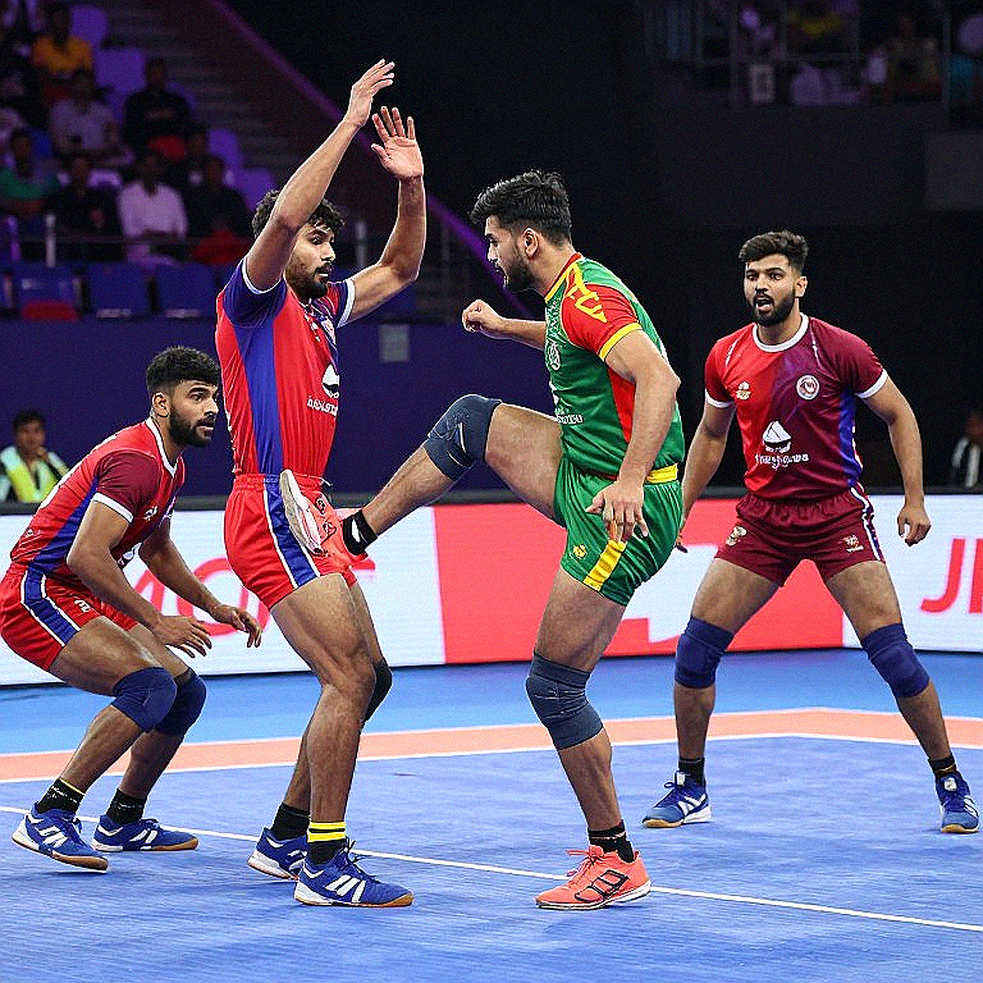
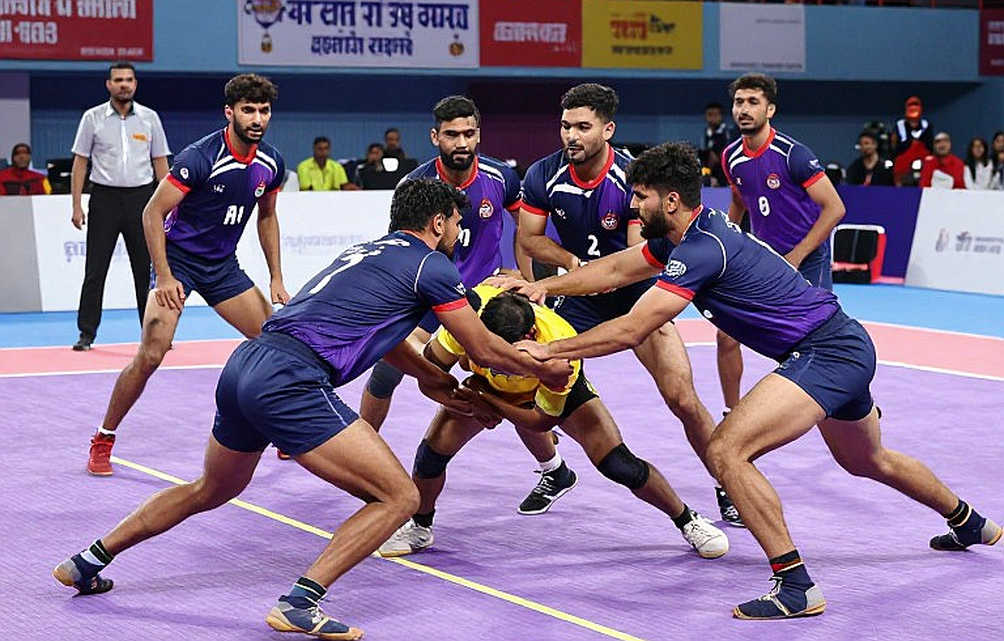
For three weeks at the back end of last season, I watched the same sequence from the commentary box. A third do-or-die raid. The raider found nothing, turned to retreat, and the left corner was already going down — ankle hold. The cover came in from the right, hand to the thigh, and the raider's whole weight settled on a foot that was pinned to the mat while his torso kept travelling forward. He got up after the fall, walked fine, went in for the next raid. Two raids later he was taken off. That night I wrote one line in my notebook: the injury did not arrive when he fell, it arrived when he was sent back out. I started with the injury and the report ended with the system that had made that injury something to be endured rather than prevented.
The Calendar Is the Vessel Into Which Every Other Decision Is Poured
Pro Kabaddi League's eleventh season began on 18 October 2026 and ended on 29 December 2026. The arithmetic I worked out from the published schedule: 137 matches, 12 teams, 73 days. In Season 10 those same 137 matches were played across 91 days — 2 December 2026 to 1 March 2026. Inside a single year the league compressed its own calendar by more than twenty per cent, while each team's league-stage fixture count stayed at 22. That number is not a conclusion in itself; it is only the vessel into which every other decision gets poured.
Kabaddi's medical history predates this league, and that history travels far behind the league's money. Before 2026, the country's best kabaddi player was a railway clerk or a police constable. His job was the security; his injury had no file. There was no rehab centre, no workload monitoring, and a "fitness test" meant the coach nodded. After 2026 came the league, the auction, the television — but medical governance stayed standing on the same railway-era mindset, except now there were crores of rupees underneath it. At the 2026 auction, Haryana Steelers bought Monu Goyat for ₹1.51 crore, at the time the biggest bid in kabaddi history. That same year in Jakarta, India's men lost the Asian Games semi-final to Iran 18-27. The two events sit on the same timeline, and that is the cleanest signal in this entire argument: the money reached a new floor, the care of the body stayed on the old one.
Most franchises run an entire season with one senior physio and one or two support staff. This is not my guess; it is the picture assembled from publicly listed support staff. Twelve teams, twenty-two matches each, constant travel between three cities, and at each team's disposal a handful of hands managing daily taping, rehab and recovery. I spoke to a former franchise physio — on the condition that neither name nor team be printed — and one line of his has stayed with me: "On match day my job isn't treatment, it's triage." That is precisely where sports medicine separates from sports management.
The Mechanism: An Ankle Hold Is Not a Technique, It Is Two Bodies Arriving Together
Never read an ankle hold in isolation. The corner's hand goes to the ankle, but the real load is created when the cover arrives at the thigh or waist while the raider's upper body is travelling one way and his foot is locked the other. Through that entire action the ankle absorbs three things simultaneously — plantarflexion, inversion and rotation. The full weight of the body plus the cover's weight, delivered to a joint whose range of motion has already been exhausted.
That is the standard lateral ankle sprain mechanism, and when the lock arrives from both sides the risk of a syndesmotic injury joins it. I am not claiming I identified a ligament off a screen — naming a diagnosis from any slow-motion clip is the biggest lie in this kind of coverage. I am describing the mechanism only; the right to diagnose belongs solely to the clinician who saw the player in a scan room rather than on a mat.
What worried me most through this season is that a raider learns how to fall, but not how to escape a pinned foot. Our training systems spend hours refining the dubki and the turn, yet there is not a single session on "if the corner grabs your ankle, how do you shed your body weight". The old players learned that craft through repetition and often learned it by breaking. The new system is repeating that same experience under the pressure of league money, without ever turning it into a curriculum.
Counting Workload, and the Dataset That Does Not Exist
I tracked match clusters between October 2026 and December 2026. Several teams played three or four matches at two-day intervals, with a city-to-city transit in between. Here I need to make one thing clear, because this is where most of the deception on this subject happens. It is easy, and wrong, to correlate PKL raid counts or minutes played with injury rates and arrive at a finding. India has no public kabaddi injury registry. When exposure data exists and outcome data does not, every correlation is an inference, not evidence. So I will not write that a compressed calendar raised injuries. I will write that the calendar compressed, and that we have no system to know what effect that had. That absence of knowledge is itself a decision.
In a 2026 survey of mine — conducted among then-current league players with a small sample — only 12 per cent had any form of injury insurance. That figure is mine, not a government registry's, and I present it as exactly that. This absence of insurance and rehab sends a direct economic signal: when injury strikes, the risk sits with the player and the benefit of a quick return sits with the franchise. Until that arithmetic changes, any "scientific rehab" protocol will look beautiful on paper and useless on the mat.
The Map of the Body: Who Gets Targeted Where
Viewed tactically, the ankle hold is not a dirty trick; it is a rational answer. The raider's weakest moment is the turn; the corner's cheapest weapon is one that stops the raider's foot and forces him to carry his own weight. After 2026 the Iranian defensive school made that logic plainer. That school, arriving out of wrestling, carries a tradition of upper-body control, thigh holds and chain tackles, and it redrew the geography of risk in front of Indian raiders. That Jakarta 2026 semi-final was not merely a scoreline; it was the first public sample of that shift.
Over the past few seasons I have logged a pattern in my notebook: raiders who are quick in their first movement get repeatedly stopped at the waist and thigh; raiders who depend on the dubki find corners dropping early to close the space. In both situations the damage lands in the same place — ankle and knee. The decline of the dubki was not one coach's decision; it is an accounting of the cost that sits between a highlight and a rehab.
The Contrarian Angle Nobody Writes
Every argument about injuries ends up parked at "rush back versus scientific rehab". I find that frame wrong, because it assumes the correct decision exists and is simply not being taken. The real problem is that the correct decision is economically wrong for the player. A raider who sits out two weeks is staking his auction value, his place in the side and next season's contract. When "fitness clearance" is issued by a physio on the franchise's payroll, that conflict of interest will be resolved by institutional design, not by a moral lecture.
The second contrarian angle is the do-or-die rule itself. When everything rides on a single raid after three consecutive empty ones, the raider's body goes to maximum explosiveness for that one moment — at the point of fatigue where control is lowest. The rule manufactures excitement for the viewer; the same rule adds an extra load to the raider's ankle. It is not a bad rule, it is simply a rule whose cost is recovered from somebody else's body.
Looking Forward
I started with the injury and ended with the system that allowed it. The mechanism was visible; the mismanagement was hidden in plain sight. The Asian Games medical room was telling a story the medal table could not — a country with four women's kabaddi golds has still not built a single professional women's league, which means where the medical infrastructure is thinnest, the neglect is deepest too. Before the next auction, read the medical file, because injury is a language and most franchises still only hear the noise. The question is not when the next raider will go down. The question is whether, by the time he does, we will have a system that counts him.